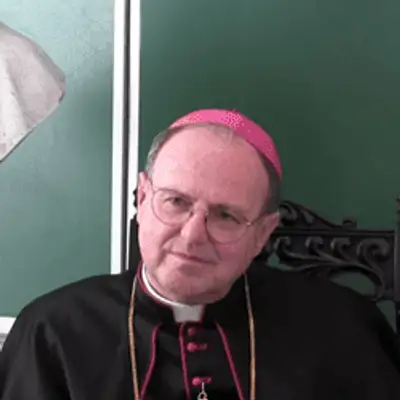
God's Mercy - Bp. Donald Sanborn 01-23-94
Download MP3In the name of the Father, and of the Son, and of the Holy Ghost, Amen.
Both the leper and the centurion in today's Gospel obtain what they have asked for and contrast these two episodes of the Gospel to that of Herod, who, at the time of our Lord's Passion, asked Him to perform miracles in front of him.
Not only did our Lord refuse to perform the miracles, He did not even answer him a word.
Why then did the leper and the centurion move heaven?
And the answer is, because their request to God came adorned with all of the proper qualities.
And the first quality is that of confidence.
We must pray with confidence.
Too often we think only of the justice of God, and do not consider His mercy.
Now it is true that the hardened Sinner is moved, if he is moved at all, by considerations of the justice of God, by consideration of hell, by consideration of purgatory.
What will happen when you sin?
And it is therefore necessary that the Church in her preaching, emphasize a great deal the justice of God in order to bring the Sinner to his senses.
But despite this necessity, we must never lose sight of the mercy of God, and we must never approach God as if He is a type of ogre who has his hand constantly raised to strike us.
God is displeased by such an image of Him in our minds, and when we approach Him in prayer, we must approach Him with confidence that He desires our good, that He is ready to give us good things.
And thus the opposite of confident prayer is timid prayer, where we go with the idea that it is virtually impossible to receive what we ask for.
We become so conscious of our unworthiness and of the justice of God that the relationship between the prayer of the Sinner and the goodness of God breaks down, and this is displeasing to God.
So we must pray with confidence, conscious of the mercy of God.
The second quality is humility, and this is the opposite of the problem that I just described.
If we go to God with presumption, that is pride, he is equally displeased.
We must go to him with humility.
We must go to him with a sufficient consciousness of our lowliness.
The prideful person goes to him with the idea that it was God's role in life to keep us happy, and when we ask for something, we should receive it.
Such a quality in prayer is obviously displeasing to God.
It is the prayer of the Pharisee who peppered his petitions with self praise.
But humility we notice both in the leper and in the centurion, and this wins the heart of God.
The third quality of our prayer is that it must be fervent.
If we go to God in prayer.
If we are seeking to open heaven by our supplication, it is necessary that we ardently desire that which we are asking for.
The leper came and knelt before him, a gesture of the intensity of his prayer.
The centurion made a special trip to him, a sign of the intensity of his prayer in the request for this miracle.
It is insulting to God to ask him for things in a careless and offhand manner.
Rather, we must go to Him with a sincere and fervent desire of what we are asking for, and we must acknowledge God as the source of all good things and pray to Him in the same manner that a child would ask a parent for something which it truly wanted or needed.
Tepid prayer will never obtain what it seeks, and thus if we really deeply desire something from God, we should accompany our prayer with sacrifice, example fasting.
And in that way our prayer will be particularly efficacious.
When the disciples returned from attempting to drive out devils and complain to our blessed Lord that they could not drive out these devils, He said to them, these devils can only be driven out through prayer and fasting.
And the costly act of fasting increases before the divine throne the intensity of our prayer of petition.
Furthermore, we must pray with faith from time to time.
In our prayer, we think these thoughts.
How is it that I have prayed for something for so long and yet I have not obtained?
It seems that nothing is different after prayer than before prayer.
No one has spoken to me.
Nothing has changed.
These thoughts go through the mind not only of lukewarm souls, but even of Saints.
These very words are the words of Saint Bernard of Clervau, who says these things have occurred to him in his prayer.
And the answer to this question or objection is the just man liveth by faith.
That's from Sacred Scripture.
The just man liveth by faith.
Faith is the vision of things unseen by faith.
We are aware of realities which are not visible to our eyes.
The stronger our faith, the more vivid and real will these realities be.
That is why Saints are capable of the most courageous acts of mortification, because in the intensity of their faith they see the connection between those acts of mortification and the future life.
They see things that cannot be seen with eyes.
They see them vividly because their faith is deep and ardent, and they thus order their lives according to their faith.
And that's what makes them Saints.
That's what makes the Saint differ from the average Catholic, that they take the faith so seriously that they order their lives accordingly.
While we, on the other hand, have a daily battle between the faith and the world.
And as we give in to the world, little by little we chip away from the faith.
It is the faith, then, that sees the value of prayer, and it esteems it more highly than anything else we do.
It is faith which makes us realise that our prayer will obtain either what we are asking for or something else which is of greater use to us.
We must also understand how God works with regard to our own perfection.
If you would picture in your mind a scale where there are weights on one side and the other side is empty.
God, when we are asking for something, wants us to posit a certain amount of prayer, fervent prayer, persevering prayer, the right kind of prayer on the other side.
What is that is, we must place enough weight of prayer to tip the scale so that God will grant what we are asking for.
And why does He put those weights on the other side for our perfection?
And thus, even if you come within a tiny fraction of an ounce less than is needed to tip that scale, it will not tip.
Thus, prayer must be persevering.
It must go on according to the principles of the faith.
We must furthermore take into consideration what we are praying for.
If we are asking for a material thing, we must have the wisdom and the humility to understand that not every material thing pertains to our good.
In fact, many material things drag us away from God and thus our prayer for a material thing must be conditioned by divine wisdom, supernatural wisdom, that perhaps this is not correct for us to ask for a material blessing.
Even good health will not be heeded by the all good God unless it pertains to our good.
When we come down with the disease, for example, or when we have some terrible problem, it does not come as a surprise to God.
It was foreseen by all from all eternity that we should have that problem.
It is part of the plan of our salvation.
The fact that the leper had leprosy in the gospel was foreseen by God from all eternity.
But it was also foreseen that he would live at the same time as our Lord, that he would live in the same place as our Lord, that he would be on that mountain when our Lord was preaching, and would go to him afterwards.
And before that great multitude would receive a miracle that was foreseen.
It was also foreseen that the centurion would be sent to Judea and that his servant would be paralysed.
All of these things are foreseen by God.
We must see things the way God sees them, not the way we see them.
We must also understand that when we ask for something, say that we be cured of cancer, which would be a miraculous thing for God to do, we must understand what the nature of a miracle is.
It is a sign to non believers we should not approach God in this way.
I am surprised that we have that I have cancer.
This I have come down with this terrible disease.
You're surprised to now Get Me Out of it?
No, this was foreseen and the only reason why he would perform a miracle to alleviate that alleviate you of that problem would be to convert a non believer, St.
Paul says miracles are for those who do not believe.
If we look, for example, at the martyrs, we see that many of them were preserved for a long time from death that should have come upon them from the tortures that were inflicted, and they went through boiling oil and diverse other tortures and came out unscathed.
And finally, usually the Romans succeeded by chopping their heads off other martyrs.
On the other hand, most of them went through their martyrdoms without any intervention of God and seemed to be abandoned by God in the same way that our Lord Jesus Christ seemed to be abandoned by God.
Yet God does not love the one martyr more than the other, but he intervenes in those ways by miracles, as in the case of today's Gospel, the leper, in order to show something, in order to prove something.
It is not that he is surprised by your disease or by your cross.
It was intended.
And if in the rare case he alleviates you of that cross, it is to prove something, to show something, either to you or perhaps to your family, to those around you, those who will believe.
Perhaps you need a miracle in order for you to believe, but miracles are for those who do not believe.
And thus we must not approach prayer in a spirit of murmuring.
We must approach prayer in a spirit of divine wisdom.
When we lose sight of the next World being our true world, the world of eternity, the world in which we will spend nearly all of our time of our existence, when we lose sight of that fact and think of this world as the world of our happiness, we begin to murmur against God.
Why does this one have all this and I have so little?
Why does this one have good health and I have disease?
Why does this one have such a nice family and I have so many problems in my family?
Why does not God answer my prayer when I go to Him with these problems?
Why does not God alleviate my crosses?
This is a murmuring.
Why?
Because we see this life as the life of our perfect happiness, and we fail.
By the eyes of faith we fail to use our faith to see that this life is a life in which we prove our perfection, in which we are brought from imperfection to perfection in the spiritual life.
It is a lack of divine wisdom, a lack of faith, which makes us murmur in such a way.
There is one soul, and there is one eternity, and the preparation for that eternity is here, and thus we are given many crosses, many opportunities of perfection.
We must see our lives in that light as we approach God in prayer.
In the case of spiritual goods, we should distinguish between those graces which we ask for ourselves and those which we ask for others.
When we ask a grace for ourselves which directly pertains to our eternal salvation, God infallibly grants that.
If you go to God and ask for eternal salvation fervently, ardently, with a contrite heart, he infallibly grants that grace.
Look at the good thief on the cross, who said so little as Remember Me when thou comest into thy Kingdom.
And he responded, This day thou shalt be with me in Paradise.
He infallibly grants that grace.
But if we should, on the other hand, ask for some spiritual good which we think would help us, say the alleviation of a certain form of temptation, example, temptations to impurity.
And if we fervently pray to God to be alleviated, and He does not answer us, but rather these temptations go on and perhaps even increase, we should not think then that God is deaf to our supplication.
For sometimes these are the things that pertain to our perfection.
The crosses, the interior turmoil, all of these things that come into our lives are for our perfection.
And all things pass like the leaves that turn brown in the fall and fall down and rot on the ground in the winter.
So our lives in this life here will do the same.
All things shall pass.
We shall all pass away, and eternity will come.
And those crosses that we have well borne and those temptations that we have thrown off by the grace of God will add to our perfection and will give us a greater crown in heaven.
That is the only consideration of this life, and we must approach our prayer of petition with that attitude.
When we pray for the salvation of others, even those who are very dear to us, we must remember that we are crossing into a very mysterious area.
When a man falls into mortal sin, it is only God's mercy which gives him the grace to return.
God is not obliged by His justice to draw him back.
It is an act of mercy.
When we ask for this mercy for another, we might be convinced that person is deserving of mercy, even if we are blinded by our love.
But God, who sees into everyone's heart, knows whether that person should be given that grace or not.
And thus we can only go with an attitude of deference to God's wisdom.
God's God, who is all merciful and who desires the salvation of all.
We can only go in deference to that and pray perseveringly.
But sometimes also he will hold out.
He will hold out on the conversion of someone in order to draw us out more.
For our love of that person might be so strong that it will fire a life of prayer in us.
It will be a furnace for our prayer life.
And God in His wisdom, seeing this and knowing this might hold out for years until we have gone through fervent prayer and sacrifice.
Then will that scale tip, and it will tip immediately.
And suddenly, like Saint Paul was thrown from his horse and converted to the faith.
Saint Monica prayed many, many years and sacrificed many, many years for her son and was given as a reward.
Not only a great doctor of the Church, a St.
one of the greatest as her crown, but also her own sanctity, that she too is now on the altar of God.
Like the leper and like the centurion.
Let us go to God with faith first, then confidence, humility, fervent desire, and perseverance, and let us not fail to thank God for what He gives us in His goodness, and even for what He refuses to us in His goodness.
In the name of the Father, and of the Son, and of the Holy Ghost.
Amen.
Creators and Guests