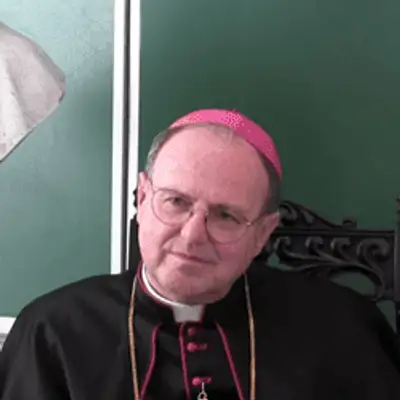
Gluttony - Bp. Donald Sanborn 02-20-94
Download MP3In the name of the Father and of the Son, and of the Holy Ghost, Amen.
Today I would like to speak to you about the fourth of the capital sins, that being gluttony.
Gluttony is an inordinate love of the pleasures of the table.
The disorder of gluttony lies in eating for its own sake, That is, not for the sake of maintaining the health of the body or eating to excess where we are eating for the sake of maintaining our health, but excessively by going beyond what we need, even to the point of harming our health and disregarding the rules of sobriety.
Now there are four different ways of being gluttonous.
The first is by eating when there is no need, for example, eating between meals and for no other reason than that of indulging our greed.
Now, that not is not to say that every eating between meals is a sin.
Not at all.
But it is to say that purely pleasure snacking or nervous snacking is a form of gluttony.
It's a venial sin.
Second way.
The second way of being gluttonous is by seeking delicacies and daintily prepared meals in order to please our palate all the more.
So excessive attention paid to how our food is prepared is a sin of gluttony.
The third way is by going beyond either appetite or need and gorging oneself with food or drink, even to the point of endangering one's health.
And the fourth way is by eating with such eagerness that we imitate animals.
Now the the malice of gluttony arises from the fact that it makes the soul a slave of the body.
It brutalizes man, it weakens his intellectual and moral life, and in an imperceptible manner paves the way to voluptuous pleasure which is very closely related to it.
Lust and gluttony go hand in hand, for they are both a an excessive and disordered appeasing of our lower appetite for pleasure.
Gluttony is a mortal sin when it goes to such lengths that it has a serious effect.
For example, if it should incapacitate us for our duties of state and life.
If you were to become so fat, for example, that you could no longer carry on your duties of state and life, or if you were to abuse alcohol to the extent that you could no longer function properly in a state of life.
Another example, when it injuries our health.
If you have heart disease, if you have diabetes and you have a special diet, the excess concerning the the dietary rules for you could be a mortal sin if it goes too far.
When our gluttony is a cost is a cause of useless expenditures which endanger the interests of the home, Here again, the abuse of alcohol is a primary offender.
People who drink too much have to spend an awful lot of money on their drink, and if they are drinkers, they very often cannot hold down jobs and the financial situation of their homes is very precarious as it is.
Another way in which gluttony would be a mortal sin is when it is the cause of other grievous faults, such as lack of chastity or sins of detraction and calumny due to intemperate speech.
Gluttony gives us a a a tendency to talk too much, to party too much, to become dissipated.
And at all of these parties and dissipated times, we tend to start talking about other people, backbiting, calumniating them, detracting from their reputations.
And gluttony is a cause of this.
And it can then become become mortal due to its attachment to these other sins of the tongue.
Usually, however, gluttony is a venial sin.
When we give in to immoderate eating and drinking, but not to the point of grave excess, it is a venial sin.
So if your host brings over a second helping and you say and says to you, oh, please have some more, and you say Oh no, and and they insist and you eat it, you know it's overeating.
That's a venial sin.
Or if you simply take too much on your plate and eat too much, that's a venial sin in itself.
Or drinking a little bit too much of alcohol is a venial sin.
Gluttony is furthermore, the enemy of perfection of the soul, if you are trying to rise to perfection.
And by the way, all must tend to perfection.
No one can say I wish just to do the minimum.
We must all tend to perfection in the love of God, at least strive toward it if we are making a serious effort to strive toward perfection in the spiritual life.
Gluttony puts an obstacle to this because it it fosters a spirit of lack of mortification.
It fosters a spirit of appeasing our lower nature when it cries out for appeasement.
Mortification is one of the essential elements of the spiritual life.
Read the life of any St.
and you'll see a great deal of mortification of one kind or another.
It is impossible even to get to heaven without some mortification, and that's the reason for the Lenten fast and the Ember days and the Friday abstinence.
But it isn't yet more impossible to achieve a a perfection in the spiritual life, or even strive toward it seriously, if there is not a mortification of our lower passions.
Gluttony develops a love of sensual pleasure, which leads the soul to impurity.
It also leads to many other faults such as excessive joking, dissipation, joking of a doubtful nature, and excessive talking.
Gluttony is an invitation to the devil to come into the soul and cause damage much worse than gluttony through other faults.
Once that surrender to the lower nature takes over, the soul is prey to the devil.
It is capable of doing anything and the the first outlet of the sensuality that gluttony produces is impurity.
And that's why those of you who have young children, it's important to teach your children habits of moderation in eating when they're young.
If they appease their desire for food at every urge when they arrive in adolescence and have temptations to impurity, they will know only the appeasement of their urges, and they will come down with a serious problem of impurity in their adolescence.
Because they have not been told moderation in their childhood, their wills are incapable of saying no to the drive of appeasement.
They become sensual, so it's a way of spoiling children by not teaching them moderation and a certain mortification in the way they approach food.
Now here we should mention to the modern obsession with health and fitness.
It is related to gluttony in as much as it is rooted in excessive care and attention paid to the body.
It is important to take care of our bodies and one can easily sin by defect in this regard, by eating a lot of junk or or not eating the right foods, not even eating enough food, and by not exercising sufficiently.
It is one is capable of sinning by defect, but there is a tendency in our society to be excessive the other way, and that is to be obsessed with exercise and the perfect body, which is closely related to vanity and lust, or through an obsession with health foods.
Some people's lives are consumed with worry about what they eat.
Every meal is an event, a planned event in their lives.
What we are going to eat, how it is going to affect my health, what vitamin I need here, what protein I need there, This is an excess.
They spend excessive amounts of money at health food stores for all kinds of purified foods.
This is a form of gluttony.
It is related to that form of gluttony which which desires excessive attention to the way in which foods are prepared.
Now for some people it becomes such an obsession that it borders on a religion and they lecture others as their friends might be putting a fast food hamburger, hamburger to their lips.
They lecture them about what's wrong with that and how you're going to die from that and etcetera.
That is an excess and and it's a disorder.
We must all understand that we are going to all die.
We're all going to die.
We none of us are going to get out of this alive.
We are all going to die.
And if we don't die of the heart attack, well, then we'll die of the stroke.
And if we don't die of the stroke, we'll die of cancer, or we might have an accident, or some other awful disease or cause might come upon us.
But we are going to all die, and we should therefore not pay excessive attention to preserving ourselves from death.
Rather, our obsession should be the health of our souls.
That should be our daily obsession.
That should be our religion.
What is the state of my soul?
And every time we kneel down to pray the rosary or our morning prayers, that should be our daily event.
And how this is going to affect the state of my soul, how well I do this, not what I eat and whether I have a bean sprout or something like that.
We're all going to die, but our souls will live eternally if we take care of them now.
The remedies to gluttony are these.
The 1st is by prayer that we understand the guiding principle that eating is not an end in itself, but exists for one purpose, the maintenance of the health of the body.
And the purpose of maintaining the health of the body is in order to give glory to God, to fulfil the duties of our state in life primarily.
And in so doing we give glory to God to be a good father, to be a good mother, to be a good child.
So that's the first thing we must understand.
The purpose of eating it is really no different than pulling into a gas station and filling up your car with gasoline.
No different.
It is the maintenance of the health of the body.
It is so that you can keep going.
The reason why pleasure is attached to it is so that we will do it.
If eating were something that were not pleasurable or even distasteful, we would all starve to death.
We would not take care of our bodies, but God, in His wisdom has placed pleasure on our tongues, so that when we put certain foods to our mouth, we are delighted and we go back.
Secondly, this purity of intention will automatically moderate our intake of food and drink to the extent that this intention retains control of the will.
For as long as we understand that this is, that eating is for the maintenance of our health, and for as long as that principle retains control of our will, we will not be gluttonous.
Then we will easily set aside that extra glass of wine, or that can of beer, as the case may be, because it does not pertain to our good.
According to the plan of God.
Only when our will breaks away and becomes the slave of pleasure will we fall into sin.
And finally, we must mortify ourselves from time to time, teaching and training our will to say no to the lights which are craved by our lower appetites.
There is a time to say no.
The Lenten fast is designed to mortify our palate, and this mortification of the palate is the costliest mortification for man.
We may not realize it, but more than any other delight in this life, we desire to eat.
We desire to eat from the moment we are born right to our deathbeds.
We want to eat.
We want something to eat.
And the other delights will come and go in our lives.
Other joys will come and go.
The joys of family life, all of those will come and go, but we always want something to eat, and thus the Lunt and fast cuts into that desire of our nature to eat.
And it teaches us first to have sorrow for our past sins by inflicting a little punishment, but more importantly, to draw us away from the interest in earthly things, and to in turn draw us to a contemplation of divine things.
In the name of the Father, and of the Son, and of the Holy Ghost.
Amen.
Creators and Guests